
Bringing on a fractional CFO is one of those decisions that can feel both exciting and slightly daunting. You know it’s the right move for your growing business, but what actually happens once they join? The first month is all about setting the foundation, getting clarity, and starting to build the kind of financial insight that lets you make confident decisions.
Here’s what you can expect in those first few weeks.
Week 1: Getting Under the Skin of the Business
Your new CFO will start by learning everything they can about your company. This means diving into your financials, but also understanding how you operate day-to-day. They’ll look at your revenue streams, cost structure, margins, and cash position, but they’ll also ask a lot of questions about your goals, growth plans, and challenges.
Expect conversations about your business model – how you make money, what’s working well, and what’s keeping you up at night. It’s part numbers, part storytelling.
You’ll also start to define what “success” looks like for this engagement. Maybe it’s building a forecast, securing investment, improving cash flow visibility, or getting your reporting in shape. Clarity at this stage helps both of you focus on what really matters.
Week 2: Cleaning Up and Getting Organised
Once your CFO understands the lay of the land, the next step is to tidy things up. This might mean making sure the accounts are properly reconciled, checking how your bookkeeping is set up, reviewing your management numbers, or identifying gaps in your financial data.
They might also streamline how you track metrics, introduce a reporting cadence, or recommend new tools to make financial management smoother.
It’s not glamorous work, but it’s essential. Think of it as clearing the clutter so you can actually see what’s going on – we like to call this Finance Hygiene.
Week 3: Building a Picture of the Future
Now that the basics are in order, your fractional CFO will start to look forward. This is where forecasting, budgeting, and scenario planning come in.
You’ll work together to build a view of your runway, test different growth assumptions, and see how various decisions might impact cash flow. You’ll probably start hearing phrases like “unit economics”, “burn rate”, and “gross margin trends” more often.
The goal is to move from reacting to your numbers to using them to make decisions.
Week 4: Turning Insight into Action
By the end of the first month, you’ll have a much clearer picture of where your business stands and what needs attention.
Your CFO will likely present a short-term action plan, covering priorities for the next quarter. That might include tightening cost control, refining your pricing, setting up dashboards, or preparing financials for investors.
You’ll also have a rhythm in place for regular check-ins and updates, so finance becomes part of your decision-making process rather than an afterthought.
The Real Value Starts Here
The first month is about groundwork, but the real value of a fractional CFO comes over time. Once the systems are in place and the data is clean, they can help you use your numbers strategically. You’ll start to make faster, more confident decisions, backed by insight instead of guesswork.
So if it feels like a lot of set-up at the start, that’s normal. It’s the foundation that lets your business grow with clarity and control.
Choosing the right fractional CFO can make all the difference in your first month and beyond. EmergeOne CFOs bring real-world experience from scaling startups and scaleups across sectors like SaaS, life sciences, deeptech, e-commerce, fintech, edtech and more, so they understand intimately the challenges you’re facing. They provide tailored support whether you’re fundraising, refining your business model, or planning an exit, and they integrate into your leadership team rather than just giving advice from the sidelines. Their flexible approach means you can scale CFO support up or down as your business evolves, giving you the right level of expertise exactly when you need it.
At Talentedge, we speak to CFOs daily about building finance teams for high-growth businesses. One theme now dominates those conversations: the rise of AI.
As AI moves beyond experimentation, finance leaders must shape recruitment strategies around AI-driven innovation to stay competitive. For fractional CFOs, this is especially exciting. Unlike those in large corporates, they’re not constrained by legacy systems or inherited teams. They can design lean, AI-ready finance functions from the ground up.
The question is no longer if AI will reshape finance teams, but how to hire people who remain relevant as automation takes on more of the workload.
The New “Must-Have” Skills
Finance leaders increasingly ask whether their teams are equipped for the age of AI. The core priorities they highlight are:
- Optimising finance processes – using AI to automate month-ends, reporting and forecasting.
- Driving technology adoption – hiring curious, innovative thinkers who can spot opportunities to embed new tools.
- Partnering the business – using data and insight to shape commercial decisions, not just report on them.
Technical finance skills still matter, but they’re no longer enough. Adaptability, curiosity and strategic thinking now define future-ready hires.
The Changing Shape of Finance Teams
Automation is rapidly reducing the need for manual processing roles such as:
- Accounts payable/receivable clerks
- Bookkeepers or data entry specialists
These functions are handled by cloud and AI-powered systems. Instead, growth businesses are prioritising:
- FP&A specialists – experts in scenario modelling, predictive analytics and AI-enhanced forecasting.
- Finance Business Partners – commercially minded professionals who translate financial data into growth strategies.
- Data & Analytics Leads – those integrating finance and operational data for a single source of truth.
- Tech-savvy Finance Leaders – CFOs and Controllers who can select, embed and optimise AI tools.
Every hire should add strategic value and help the finance function scale intelligently.
The Growth Mindset Advantage
Skills can be taught; mindset determines long-term value. A “growth mindset” in finance means:
- Embracing new systems and tools quickly
- Seeing technology as an enabler, not a threat
- Continuously upskilling and experimenting
- Staying resilient when processes evolve
That’s why many CFOs now hire for adaptability over a “perfect CV.” In a fast-moving tech landscape, the ability to learn outruns any single system expertise.
Interviewing for AI Readiness
When designing interview processes, forward-thinking CFOs go beyond technical competence. They test for curiosity, problem-solving and openness to change.
Questions to gauge AI adaptability:
- What tools or technologies have you implemented or improved?
- How have you used automation or analytics to enhance decision-making?
- If we introduced a new tool tomorrow, how would you learn and embed it?
- Which area of finance will AI transform most in the next three years?
Questions to uncover growth mindset:
- Tell me about a time you took on something outside your comfort zone.
- What’s a skill you’ve recently taught yourself?
- How do you keep your skills relevant as finance evolves?
These questions reveal curiosity, initiative and resilience, qualities that future-proof finance teams.
Why This Matters for Fractional CFOs
Fractional CFOs enjoy a rare advantage: they can design finance teams for today’s needs and tomorrow’s opportunities. They can:
- Keep teams lean with outsourcing and automation for transactional work
- Focus hiring on strategic, insight-driven roles
- Prioritise adaptability and tech fluency
- Oversee smooth transitions until permanent structures are ready
Freed from legacy constraints, they can build AI-ready teams from day one.
Founded in 2006, Talentedge helps startup and scaling businesses find permanent and interim finance talent that support growth and deliver strategic goals.
For many growing companies, international hiring is no longer a “nice to have” but a core part of the strategy. Expanding your team across borders opens access to new talent pools, helps you get closer to customers, and supports around-the-clock operations.
But with those opportunities come new layers of complexity. Salaries, benefits, and tax obligations differ from country to country. Payroll and compliance requirements can catch teams off guard. And unless financial models are aligned with hiring plans, founders risk running into cashflow problems or compliance issues that slow growth.
Getting this right requires a joined-up approach, where finance and operations work side by side to plan, model, and execute global hiring in a sustainable way.
EmergeOne | Financial Modelling & Forecasting
When companies start thinking about international hiring, the first instinct is often to focus on where the best talent is and how quickly they can get someone in seat. But without a clear financial model, those decisions can quickly create problems down the line.
At EmergeOne, we work with founders to build headcount assumptions directly into their financial forecasts. That means not just salary, but also factoring in benefits, pensions, employer taxes, and the additional overheads that vary country by country. These are the hidden costs that, if ignored, can dramatically shorten runway.
We also help stress-test different scenarios. What happens if you scale the engineering team in Poland instead of the UK? How does hiring in Brazil affect FX exposure and cashflow? By modelling these options before committing, founders can make informed choices and avoid nasty surprises.
Fractional CFOs bring the expertise to align hiring plans with realistic financial forecasts, ensuring global expansion supports growth rather than undermining it.
Accounting for hidden costs
Hiring internationally is never as simple as converting a salary into another currency. Each market comes with its own rules and obligations. In France for example, employer social contributions can add a significant premium on top of salary. In Brazil, FX volatility can turn a predictable payroll into a moving target. In the US, healthcare benefits are a major expense. These hidden costs, if overlooked, can shorten runway far faster than expected.
A well-built model helps to surface these factors early so that they can be planned for rather than discovered when cash is already tight.
Stress-testing scenarios with a fractional CFO
One of the most valuable roles a fractional CFO plays is helping founders test different scenarios before committing to a hiring plan. What if you grow your engineering team in Poland rather than the UK? How does opening a sales hub in Germany compare with hiring locally in Spain? What happens to cashflow if the currency moves against you?
By running these scenarios, founders can see not just the headline salary difference but the full financial impact. This means expansion plans are built on solid ground, and growth is supported rather than undermined by hiring decisions.
Fractional CFOs bring the expertise to align hiring with realistic forecasts. The result is that global expansion becomes an opportunity to extend runway and support growth, not a surprise drain on resources.
Simplifying payroll, compliance and contractor management across borders
EOR: speed and compliance in new markets
The global talent race isn’t slowing down. To compete, businesses need the ability to hire anywhere fast, without tripping over compliance.
Traditionally, companies had two choices: set up a local entity or sponsor visas. Both are costly, slow and packed with red tape. That’s time lost and opportunities missed.
An Employer of Record (EOR) flips the script. This model allows companies to hire quickly in new markets without setting up a legal entity. The EOR partner becomes the legal employer of your workforce, handling payroll, benefits and compliance. You focus on growth.
Take a US-based fintech provider expanding into Germany. Instead of months setting up a subsidiary, they used an EOR to onboard a local project management lead in weeks. The EOR managed employment, benefits and taxes. The client gathered market insights, scaled faster and stayed compliant.
An EOR solution isn’t just a workaround. It’s your strategic lever for global business expansion. Whether you’re testing a market, managing M&A carveouts or scaling across regions, an EOR removes friction. It delivers compliance without delays and without hassles.
EOR can be used as a “bridge” solution, enabling you to build your team while you set up a local entity. Sometimes, particularly with smaller headcounts, it can make sense as a long-term solution.
Speed matters. Compliance matters more. An EOR gives you both.
Navigating global payroll with an integrated platform
Payroll may look simple but when you take it across borders, complexity mounts and you can put yourself at risk. Each country brings different taxes, benefits and reporting requirements. Missteps pile up fast. The result? Compliance gaps, delayed approvals and frustrated teams drowning in reconciliation.
GoGlobal’s integrated payroll solution BlueOcean changes that. We keep payroll local, processed by in-country experts who know the rules. Then we connect the dots globally with centralized reporting.
The benefit? Real-time variance detection, contextualized error checks and streamlined approval workflows. Instead of firefighting mistakes, your payroll, finance and compliance teams see problems before they escalate.
A global e-commerce brand processing payroll across 12 countries used BlueOcean to flag a sudden tax spike in Germany, before it became a compliance nightmare. Errors caught early. Delays avoided.
Payroll isn’t just paying people. It’s the foundation of trust, compliance and financial control. By combining local expertise with intelligent reporting, we make it seamless.
Across borders, payroll becomes predictable when you use an integrated platform. Finance gains visibility. Compliance stays watertight. This way, your team spends less time fixing errors and more time driving strategy.
Avoiding misclassification and compliance pitfalls
Independent contractors (ICs) are now central to the global workforce. They bring agility and expertise, helping companies scale fast. But specialty and flexibility come with risk. Misclassify a contractor and the fallout can be brutal: fines, back taxes, invalid contracts and even permanent establishment exposure.
The problem? Classification rules vary by country. Contracts alone don’t protect you. Authorities look at how work is done, not what the contract says. Set hours, provided equipment, exclusivity—these can all flip an IC into “employee” status.
An Agent of Record (AOR), like AOR Pro by GoGlobal, is how smart companies avoid that trap. The AOR acts as an intermediary, structuring IC engagements correctly across borders. It ensures contractors stay compliant with taxes, registrations and invoicing—while companies reduce legal exposure and avoid PE risks.
Consider a company hiring contractors in multiple jurisdictions. Without support, the setup could signal a hidden permanent establishment. With AOR Pro by GoGlobal, engagements are structured to protect both sides.
Contractors get transparency and timely payments. Companies get compliance, without the cost of opening entities.
Contractors aren’t a loophole. They’re a strategic asset and you need to maintain the right dynamic and relationship. Compliance is non-negotiable. An AOR gives you the confidence to scale with independent talent, without risking fines, liabilities or tax headaches.
Sustainable Global Hiring Requires a Unified Approach
International hiring is more than just finding talent—it’s about building a sustainable, scalable framework that supports long-term growth. Finance and operations must move in lockstep to anticipate costs, mitigate risks and keep expansion on solid ground.
With the right financial modelling from EmergeOne, companies gain the foresight to make informed decisions about headcount, costs and market entry. Paired with the seamless payroll and compliance expertise of GoGlobal, businesses can execute those decisions quickly and confidently.
Together, these approaches transform global expansion from a complex challenge into a strategic advantage—helping growing companies hire anywhere, stay compliant and scale smarter.
Contact GoGlobal or EmergeOne to talk with an international expansion expert about how our cross-border solutions can support your business goals.
For scale-ups, growth is only half the battle. The real challenge is building and maintaining trust from investors who want confidence their capital is in safe hands, trust from customers who expect reliability, and trust from employees who need to know the business has a stable future. Without trust, even the strongest growth story can unravel.
Two areas matter most in creating that foundation: finance and risk management. Numbers need to be clear, credible, and investor-ready. Risks need to be anticipated, managed, and covered. When both are in place, scale-ups signal control, resilience, and long-term viability.
In this piece, we’ll explore those two trust-builders. EmergeOne will unpack how fractional CFOs bring financial control to growing businesses, while Capsule will show how smart insurance protects against risk and strengthens credibility. Together, these approaches give scale-ups the tools to grow with confidence.
- Smart Finance: The Role of Fractional CFOs
To scale successfully, businesses need more than sales momentum, they need financial discipline. Many scale-ups hit a wall because their numbers don’t keep pace with their ambitions.
The finance challenges scale-ups face
- Messy reporting: Data lives in too many spreadsheets, making it hard to see a true financial picture.
- Cash flow strain: Growth eats capital, and without forward-looking planning, businesses risk running dry.
- Fundraising gaps: Investors expect sharp financial models, not back-of-the-envelope projections.
- Decision-making blind spots: Without solid financial insight, leaders fly on gut instinct instead of evidence.
How fractional CFOs help overcome them?
Fractional CFOs bring board-level expertise without the full-time cost. They put scalable financial systems in place, forecast cash flow and runway with precision, and translate complex numbers into clear insights leaders can act on.
How clear financials build investor and stakeholder trust?
Investors back businesses they understand. Clean, credible numbers show control, reduce risk, and give confidence that growth is sustainable. For teams, transparent financials align leadership around shared goals and realistic expectations.
With fractional CFO support, scale-ups unlock measurable results:
- Smoother fundraising: Investor conversations move faster with numbers that stand up to scrutiny.
- Stronger decision-making: Leadership can invest, hire, and expand with confidence.
- Sustainable growth: Cash flow is protected, risks are flagged early, and growth is strategic rather than reactive.
EmergeOne provides scale-ups with experienced CFO expertise on a fractional basis, delivering board-level financial leadership without the overhead of a full-time hire. From seed to Series B, we equip businesses with the financial systems, investor-ready models, and strategic insight needed to drive sustainable growth.
- Smart Insurance: Protecting What Matters
For fast-growing scale-ups, risks aren’t just vague ideas or theoretical possibilities, they are real and evolving. As you raise capital, expand your team, and enter new markets, what once seemed like a minor issue can quickly become business critical. From cyber threats to product liability or the sudden loss of a key team member, growth brings greater exposure. But with the right insurance in place, these risks become manageable and are even opportunities to build trust.
Insurance plays a powerful role in building trust. Internally, it reassures your team that they’re protected. Externally, it shows investors, customers, and partners that you take resilience seriously. Enterprise clients may require proof of cover before signing deals. Investors, too, want to know their capital is protected. They’ll ask about Directors’ and Officers’ insurance to protect leadership, or Key Person cover to make sure the business can weather the loss of a founder. The right insurance helps deliver all of that.
It’s not only about safeguarding against the worst. Smart insurance unlocks momentum. It speeds up due diligence, strengthens contract negotiations, and enables international expansion without hesitation. We’ve seen scale-ups win competitive deals, bounce back quickly from cyber incidents, and navigate supply chain issues, all because they had the right cover in place.
Working with a specialist broker means having a partner who understands the scale-up journey. They don’t just go through the motions, they help shape an insurance strategy aligned to your goals. The result is a programme that protects your people and operations today, while supporting credibility and confidence for what’s next.
At Capsule, we tailor insurance to where you are now, and where you’re going. That means anticipating future risks and ensuring you’re ready to meet them head-on.
Smart insurance is more than protection. It’s a growth tool, a trust signal, and a foundation for long-term success.
Trust is the currency of scale-ups. Investors, customers, and teams all want proof that growth is being built on solid ground. That proof comes from two places: clear financials and strong risk protection. Smart finance, powered by fractional CFO expertise, ensures scale-ups have the systems, forecasts, and models to back their ambitions. Smart insurance turns uncertainty into resilience, protecting people, assets, and operations while signalling credibility.
For scale-ups ready to take the next step:
- EmergeOne can help you put financial control at the heart of your growth with fractional CFO support.
- Capsule can build an insurance strategy tailored to your journey, protecting what matters today while preparing you for what’s next.
With the right finance and insurance partners, scale-ups don’t just grow, they build trust, and that’s what makes growth sustainable.
For early-stage startups, talent is your most valuable asset – and also your biggest challenge. You need to recruit the best people, keep them motivated, and convince them to stay, often without the budget to match corporate salaries.
That’s why more and more founders are turning to the Enterprise Management Incentive (EMI) scheme – a government-backed share option plan built specifically for smaller, high-growth UK companies. EMI gives employees a stake in the company’s success while allowing founders to offer competitive, long-term incentives without draining cash reserves.
What is EMI?
The Enterprise Management Incentive scheme lets you grant share options to selected employees on terms you choose. These options give them the right to buy shares in the future at a set price, typically today’s market value. If the business grows, those shares can be worth significantly more when sold – creating a tangible reward linked directly to the company’s success.
Unlike other HMRC-approved share schemes, EMI is designed for agility. There’s no requirement to offer it to everyone on the same terms, and the limits are generous – up to £250,000 in options per employee and £3 million in total unexercised EMI options for the company.
Why EMI works for startups
EMI’s power lies in how it connects personal reward to business success. When employees become co-owners, they:
-
Think more like founders
-
Stay longer to see their efforts pay off
-
Care more about the bigger picture, not just their own role
For founders, it’s about creating a motivated, engaged, and aligned team — without the constant fear of losing key people to better-paid roles elsewhere.
Who qualifies?
For companies:
-
Fewer than 250 full-time equivalent employees at the time of grant
-
Less than £30 million in gross assets
-
Independent UK trading company (some sectors excluded, e.g. banking, legal services, property investment)
For employees:
-
Must work at least 25 hours per week or 75% of their total working time
-
Must not hold more than 30% of the company’s share capital before grant
Benefits for Founders
For early-stage companies, EMI is more than a tax perk — it’s a strategic growth tool:
-
Targeted incentives: Choose exactly who to reward and how much equity to offer.
-
Retention built-in: Use time-based or performance-based vesting to encourage long-term commitment.
-
Cash-friendly growth: Offer genuine value without inflating salary bills or straining your cash flow.
-
Tax advantages: No employer National Insurance Contributions (NICs) on qualifying options and Corporation Tax relief on the gain when exercised.
-
Investor-friendly: Many investors view EMI schemes positively, as they help align the whole team’s incentives with growth and exit goals.
“We needed an EMI option scheme to incentivise employees. FounderCatalyst delivered a complete end-to-end package — slick, cost-effective, and with human support all the way through.”
Benefits for Employees
For team members, EMI options are one of the most attractive reward structures available:
-
Real ownership potential: Buy shares at today’s price, even if the company’s value increases dramatically.
-
Tax-efficient gains: No Income Tax or employee NICs on grant or exercise (if qualifying), and just 14% Capital Gains Tax on sale under Business Asset Disposal Relief (BADR). BADR are taxed at a tax rate of 14% (10% before 6 April 2025, and 18% from 6 April 2026).
-
Alignment with the business: When the company grows in value, they share in the upside.
-
Flexibility: Up to 10 years to exercise options, providing control over timing.
-
Long-term wealth creation: The potential for a meaningful payout on an exit or IPO, rewarding loyalty and performance.
How EMI works in practice
The table compares the tax treatment of Enterprise Management Incentive (EMI) options with unapproved share options from the perspective of both the employee and the employer. It illustrates how tax liabilities arise at each stage of the option lifecycle: grant, exercise, and eventual sale of the shares.

A key difference is the tax timing issue. With EMI, no tax is due either at grant or on exercise, even if the shares have significantly increased in value since the grant date. The employee only faces a liability when they sell the shares and realise actual proceeds. By contrast, unapproved options create a problem because income tax becomes payable at exercise, even though the employee has not yet received cash from selling shares to fund that bill.
The employee tax impact is also far more favourable under EMI. In the example, Sarah pays only £17,100 of capital gains tax (CGT) on the £95,000 growth in value when she eventually sells her shares, benefiting from Business Asset Disposal Relief (BADR), which applies at 18% from April 2026 (14% after April 2025). By contrast, James, holding unapproved options, is taxed twice: first at exercise, when £20,250 of income tax is due on the £45,000 gain from grant to exercise, and then on sale, when a further £12,000 CGT is payable on the £50,000 gain realised after exercise. His combined tax burden of £32,250 is nearly double Sarah’s.
With EMI options, BADR is relatively easy to secure: employees need only hold the options or resulting shares for two years from grant and remain employed at the time of sale, with no minimum shareholding requirement. By contrast, unapproved options require the tougher “personal company” conditions – holding the shares for at least two years, owning at least 5% of share capital and voting rights, and being entitled to 5% of profits or sale proceeds.
From the employer’s perspective, EMI is also more efficient. Corporation tax (CT) relief is available on the option gain at exercise (worth £11,250 in this example), and no employer NICs are due. With unapproved options, the employer can claim slightly higher CT relief (£12,803), but this comes at the cost of an additional £6,210 NIC liability. Net, the employer is in a stronger position under EMI.
Overall, EMI structures offer clear advantages: tax is only triggered at a liquidity event, employees pay less and at lower CGT rates, and employers avoid NIC costs while still benefiting from CT relief.
The 2025 HMRC data
Latest HMRC figures highlight EMI’s dominance in the share scheme landscape:
-
89% of companies using tax-advantaged schemes opt for EMI.
-
99% of those companies rely on EMI alone.
-
The average EMI option value in 2024 was £12,340 – far higher than other approved schemes like SAYE (£6,070) or SIP (£220).
This shows that EMI delivers more value per participant, which matters for early-stage companies aiming to make equity awards feel significant.
The bottom line
If you’re building an early-stage UK startup and want to reward, retain, and truly motivate your best people, EMI share options are one of the most powerful tools available.
For founders, they’re cost-effective, flexible, and tax-efficient. For employees, they offer a real stake in the future and the chance to share in the wealth they help to create.
When structured well, EMI schemes aren’t just a benefit – they’re a cultural signal that everyone is in it together, working towards the same goal and the same success.
At FounderCatalyst, we help founders make their UK startups investor-ready, close funding rounds, and motivate their teams. We handle SEIS and EIS advance assurance, fundraising legal paperwork, data rooms, cap table management, and set up EMI and unapproved share option schemes. Book a call with an expert to learn more.
Written By
Rebecca Gibson
What investors look for in your numbers at Series A
Raising your Series A is a big milestone. You’ve moved past the early idea and MVP stage, you’ve got traction and starting to approach that magic PMF (product market fit), and now you’re looking to scale. But before investors hand over the cheque, they’ll dig deep into your numbers.
Here’s what they’ll be looking for.
Revenue traction
At this stage, investors want to see that people are willing to pay for what you’ve built. This isn’t about profits yet, but they’ll expect signs of commercial momentum.
- ARR/MRR: In most cases, they’re looking for anywhere upwards of £1 million in annual recurring revenue, depending on your sector.
- Growth rate: You should be growing 2–3x year on year. Slower growth can be fine if you’ve got high-value enterprise deals, but the growth story still needs to be compelling.
- Revenue quality: Recurring revenue is gold. One-off sales are less interesting unless they lead to long-term customers.
Customer metrics
Investors want to know your customers are sticking around, and that you’re acquiring them in a sustainable way.
- CAC (Customer Acquisition Cost): How much it costs to bring a new customer through the door.
- LTV (Customer Lifetime Value): How much value you get from that customer over time.
- LTV:CAC ratio: Ideally 3:1 or higher. Anything below 2:1 raises questions about your go-to-market model.
- Churn rate: Especially if you’re a SaaS business, churn tells them whether customers are actually getting value.
If you’ve got usage data, show it. If you don’t, customer retention and testimonials help prove your case.
Unit economics
This is all about proving that the more you grow, the more efficient and profitable you’ll become.
- Gross margin: Most SaaS businesses aim for 70% or more. Hardware or marketplace businesses will be lower, but the margin still needs to improve as you scale.
- CAC payback period: Investors like to see payback in under 12 months, which means your marketing and sales spend isn’t a long-term cash drain.
- Sales efficiency: Revenue per sales rep, conversion rates, sales cycle length — all of these paint a picture of how well your team is performing.
Burn rate and runway
This is about survival. Investors want to know how long your business can operate without raising again, and how wisely you’re spending cash.
- Burn multiple: This is how much you’re burning for every £1 of net new ARR. A burn multiple of less than 1 is excellent, but anything up to 2.5 is typical depending on growth and sector.
- Runway: Ideally, you’ve got 12–18 months post-raise, giving you time to execute the plan, hit those milestones and get ready for Series B.
Numbers tell a story
At the end of the day, your numbers are a narrative. They show whether your business is working, whether it can scale, and how confident investors can feel about backing you.
But getting the story straight isn’t always easy. Founders are often buried in day-to-day operations and don’t always have time to build clean dashboards or model out ten different scenarios for investors. That’s where we come in.
At EmergeOne, we work with scaling startups to make sure their numbers make sense: not just internally, but to the people writing cheques. Whether you need a solid financial model, help with board reporting, or someone to join investor meetings and back up your pitch, we’ve done it all.
If you’re gearing up for a Series A raise and want to make sure your numbers tell the right story, let’s talk.
So, you’re thinking about becoming a fractional CFO? Here’s what you need to know!
Fractional CFOs are really gaining traction these days. More startups and growing companies are bringing in experienced finance leaders on a part-time basis. If you have a solid finance background and are looking for more flexibility, variety, or independence, this could be the perfect path for you. But what does it really take to step into the role of a fractional CFO?
1. Get the Experience First
This one’s a given, but let’s be clear: being a fractional CFO isn’t a beginner’s job. Most fractional CFOs have at least 10-15 years of experience, and usually some time spent in a full-time CFO or finance director role.
You’ll need to have seen the inner workings of a company’s finances, ideally across different growth stages. If you’ve helped raise money, built financial models, managed cash in a downturn, or sat in board meetings, you’re in a strong position.
2. Be More Than Just Numbers
Founders aren’t just hiring someone to build another spreadsheet. They want a strategic partner. Someone who can translate numbers into narrative and narrative into strategy. Someone who can talk to investors, challenge hiring plans, and bring clarity to chaotic situations.
That means you need to be comfortable stepping outside the finance box. Can you simplify complex problems? Can you ask awkward questions? Can you guide decisions even when things are ambiguous?
If so, you’re halfway there.
3. Nail the Basics: Forecasting, Cashflow, Fundraising
You don’t need to be an expert in everything, but you do need a strong grip on the fundamentals. At a minimum, you should be confident with:
- Building and maintaining a rolling forecast
- Running cashflow scenarios and giving founders visibility
- Supporting fundraising (equity and debt), including prepping decks and data rooms
- Creating financial models that actually make sense to non-finance people
- Understanding the business model, KPIs and metrics that drive the business
Specialisms like hardware ops, international expansion, or M&A can be a bonus – though increasingly asked for – but the core job is helping founders understand what’s going on and what’s coming next – and importantly, how much cash it’s going to take to get there.
4. Build a Fractional-Friendly Mindset
You’re not joining the team. You’re not climbing the ladder. You’re there to add value quickly, work independently, and know when to step back.
That means:
- Being clear about scope and availability
- Getting up to speed fast
- Knowing how to manage stakeholders across time zones and calendars
- Saying no to work that doesn’t fit
It also means being OK with not always being in the loop. You’re not there to run the show — you’re there to support it.
5. Get Your House in Order
If you’re going freelance or setting up a limited company, you’ll need to sort the admin side:
- Contracts
- Invoicing
- Insurance
- Data protection
- GDPR if you’re handling sensitive info
It’s not the most glamorous stuff, but getting it sorted up front saves stress later.
6. Start with One Good Client
Don’t try to launch a full fractional CFO offering overnight. Start with one client. Focus on adding value. Get a great testimonial.
Most fractional CFOs grow through word of mouth, so one strong engagement can lead to another – and another.
Final Thoughts
Becoming a fractional CFO is about bringing your experience to companies that need it, without being tied to just one. It’s strategic, it’s flexible, and yes, it’s very in demand right now.
But the best ones don’t just crunch numbers, they help founders sleep better at night.
You don’t need a full-time CFO to get ready for investors. In fact, most early-stage startups shouldn’t hire one. It’s expensive, often premature, and rarely the best use of resources. But that doesn’t mean you can wing it when it comes to financials. Investors still expect a level of clarity, structure and confidence that goes well beyond spreadsheets and guesswork.
Here’s how you can get investor-ready without bringing on a full-time CFO.
- Know what investors actually care about
You don’t need a 100-page financial model or five-year forecasts that pretend to know the unknowable. Investors want to see that you understand your numbers, your levers, and your plan for growth. They’re looking for:
- A clean, accurate P&L and Cash Flow
- And understanding of runway and burn rate
- A good understanding of your Unit Economics
- A clear funding ask, and the milestones it’ll help you reach
- Realistic use of funds
You should be able to speak to each of these confidently, even if you’re not the one building the spreadsheets.
- Get your financials in order
Before you think about raising, tidy up the basics. This means:
- Up-to-date bookkeeping
- Clear categorisation of revenue and costs
- A move from cash to accrual accounting
- A simple reporting structure that you understand
It sounds obvious, but messy accounts are one of the biggest red flags investors see early on. You don’t need bells and whistles, but you do need your house in order.
- Build a fit-for-purpose model
You don’t need the fanciest financial model. You do need a model that fits your stage and shows how you think about your business. That might mean:
- A simple 12- to 36-month forecast
- Base case, best case, and worst case scenarios
- Key assumptions clearly laid out
- Growth drivers mapped to spend
A good model helps you get clear on what you’re asking for and why. It also shows investors that you understand the trade-offs ahead.
- Bring in experienced help (without hiring full-time)
This is where a fractional CFO can be a game-changer. Instead of hiring someone full-time, you bring in an experienced operator who’s worked with early-stage businesses and knows what investors are looking for.
They’ll help you:
- Build or clean up your financial model
- Stress-test your assumptions
- Structure your fundraising narrative
- Join calls or investor meetings if needed
You get the strategic input without the long-term commitment or full-time salary.
- Practice the narrative, not just the numbers
Investors invest in stories, not just spreadsheets. You’ll need to connect your numbers to your vision in a way that’s compelling and grounded. That means being able to explain:
- Where the business is now
- Where it’s going
- How much capital you need to get there
- What success looks like in 12, 18, or 24 months
This is where founders often trip up. They know the product and the mission, but they haven’t linked the numbers to the story. A good fractional CFO will help you bridge that gap.
Final thought
Getting investor-ready doesn’t mean becoming a finance expert overnight. It means showing that you take the financial side seriously, even if it’s not your background. With the right support, you can build the confidence and credibility investors look for, without hiring a full-time CFO before you need one.
If you’re close to raising or thinking about it in the next 6 to 12 months, it’s worth bringing in a fractional CFO early. The earlier you start prepping, the smoother the process will be.
If you’re building a business and wondering whether it’s time to bring in some financial help, you’re not alone. One of the most common questions founders ask is, “Do I need a CFO, or can a bookkeeper handle what I’ve got going on?”
The short answer: it depends on the stage of your business, your goals, and the complexity of your finances.
But if you want to learn more, the first thing you need to do is to understand the difference between a bookkeeper’s and a CFO’s responsibilities.
In simple words, think of a bookkeeper as the person who keeps your financial engine running day to day. They handle tasks like:
Recording transactions
Reconciling bank accounts
Managing payroll
Making sure bills get paid
Generating basic financial reports like your P&L and balance sheet
A good bookkeeper keeps your books clean and accurate so you can stay organized and avoid headaches when it’s time to file your accounts. If you’re an early-stage business with straightforward income and expenses, a bookkeeper might be exactly what you need.
A CFO (Chief Financial Officer) operates at a much more strategic level. They use your financial data to help you make big-picture decisions. That can include:
Forecasting cash flow and helping you plan ahead
Building budgets and financial models
Helping with fundraising or manage investor relations
Optimising your margins and spending
Advising on pricing, hiring, and growth strategies
In short, a CFO helps you understand the “why” behind the numbers and what to do next. They’re thinking six months or two years ahead, not just closing the books each month.
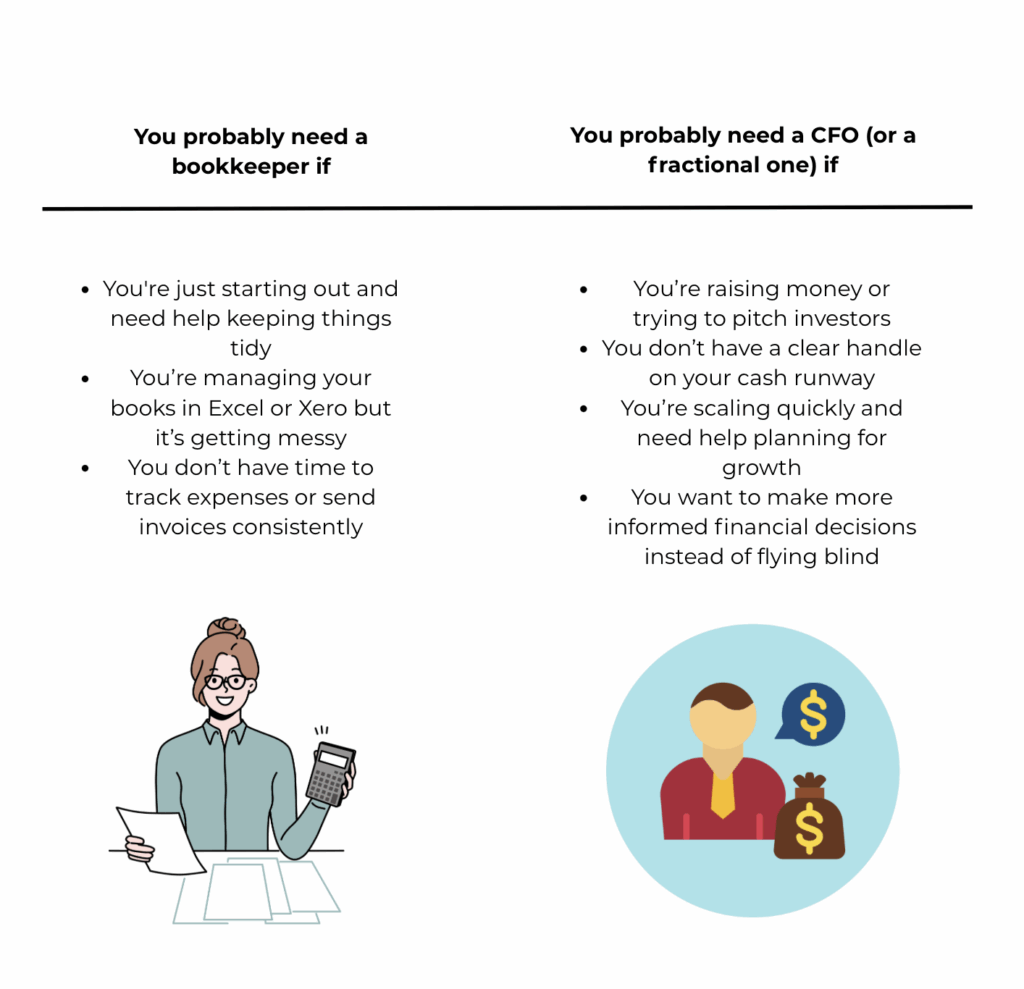
So Which One Do You Need? Here’s a quick gut check:
You probably need a bookkeeper if:
The Sweet Spot: Having Both
In many growing companies, the ideal setup is both a bookkeeper and a fractional CFO. The bookkeeper keeps the records clean. The CFO makes sense of those records and helps you chart the path forward.
They do very different jobs, and having one doesn’t replace the other.
Hiring a bookkeeper is about staying organised. Hiring a CFO is about getting strategic.
You don’t have to build a full finance team from scratch. With EmergeOne, you get the right people at the right time – without overhiring or overpaying.
Book a call with us to learn more!
So, you’ve hit that inflection point. Things are growing, numbers are getting messy, and your gut isn’t quite enough to steer the business anymore. You need financial clarity, but you’re not ready for a full-time CFO just yet.
This is exactly when hiring a fractional CFO might be just what you need to change the game.

A fractional CFO gives you access to senior financial leadership without the cost or commitment of a full-time hire. They plug into your business on a flexible basis, help you build strategy and strategic insight, and bring a level of financial discipline that most startups don’t realise they’re missing until they have it.
Here’s what to expect when you bring one on board.
A good fractional CFO doesn’t just build models or clean up reports. They help you see what’s coming next and how to prepare for it. This might be raising a round, managing runway, understanding your margins, building a proper forecast, or something you hadn’t even considered. Fractional CFOs can help turn your goals into a financial plan that actually delivers.
They’ll look at what’s happening now, where the risks are, and what levers you can pull to move faster, smarter, but with the sort of discipline that means you’re not burning through capital faster than you should be.

Don’t be surprised if your first few sessions feel less like finance and more like a deep dive into the business. They’ll want to know everything: revenue streams, costs, churn, team plans, roadmap, customer behaviour, product and all the things that make your business tick. All of it to make sure that you are receiving the best advice and service possible.
If your current setup is a mix of spreadsheets, gut feeling, and crossed fingers, you can expect that to change fast. Your CFO will set up regular reporting, cash flow forecasting, KPI tracking, and a financial rhythm that makes decision-making a whole lot easier.
You’ll stop wondering how much runway you have or whether that new hire is affordable. You’ll know.

Additionally, if you’re gearing up for a fundraise, a fractional CFO is a huge asset. They’ll help build your model, make sure your numbers match your narrative, and get you ready for investor scrutiny. They can also support calls, prep materials, handle due diligence, and even work with you on term sheet negotiations.
Basically, they help you show up with confidence and numbers to back it up.
One of the best things about a fractional CFO is that you don’t need them in the business all the time. Some weeks you might need them in deep, especially during a raise or period of rapid growth. Other times, you might just need a few hours to review the numbers and plan ahead.
It’s designed to flex around your stage, your priorities, and your budget.
The best fractional CFOs bring experience beyond finance. They’ve seen what works and what doesn’t. They understand product-market fit, pricing strategy, hiring plans, investor relationships, and operational efficiency. They’re sounding boards. Partners. Quiet operators who make a big impact behind the scenes.

At EmergeOne, we’ve provided fractional CFO support to dozens of high-growth businesses from Seed to Series B and beyond. Companies like AutoGen A.I, ThinkSono, BioCorteX, and GoInstore (who we helped through a 9-figure exit) have all seen the value of fractional CFO support at the right stage.
Our team is made up of experienced finance leaders who get startups. And we’re trusted by VCs too, many of whom refer their portfolio companies to us when they hit that critical financial tipping point.
If you’re thinking about getting your first CFO, but you’re not sure what’s right for your business, let’s talk. We’ll help you figure out what you actually need and whether it makes sense to go fractional right now.
Call us, email us, or fill out the form on our site. We’re here when you’re ready to take the next step.